
Indian economist Kalpana Kochhar, who heads the Human Resources Department of the International Monetary Fund, is leaving the organisation to join the Bill and Melinda Gates Foundation, the IMF announced on Wednesday. Kochhar, who served in various senior positions during her three decades at the IMF, will retire on July 30, it said.

Emerging nations have discussed delinking the quotas from the governance reforms to facilitate its passage.

"Now is the time for countries with room in their budgets to deploy -- or get ready to deploy -- fiscal firepower. In fact, low interest rates may give some policymakers additional money to spend," new IMF chief Kristalina Georgieva said.

Li is currently attending the WEF annual meeting in Davos in back drop of release of the annual GDP figures by China highlighting the continuation of the slowdown of the world's second largest economy.

The task force will look at emerging markets, technology, regulatory and monetary policies, loss of trust in financial services, and financial inclusion.

The Budget 2015-16 will include many of the schemes announced by Prime Minister Narendra Modi such as smart cities and high speed trains, Finance Secretary Arvind Mayaram said.

'We are cautious only on sub-sectors that have seen massive melt-up during the past six months.'

India needs to move towards full capital account convertibility to become a leading global economy.

The venture is seen as a rival to the World Bank.

Other top losers in the Sensex pack included Bharti Airtel, Asian Paints, TCS, HCL Tech, Tata Steel, SBI, IndusInd Bank and Hero MotoCorp, declining up to 3.28 per cent.

Governments that did not respect the central bank's independence would sooner or later incur the wrath of financial markets, ignite economic fire, and come to rue the day they undermined the regulatory institution, Deputy Governor Viral Acharya warned.
That is bad news for officials taking part in discussions at the International Monetary Fund and World Bank meetings this week.

While the economy seems to be on a firm growth path, the fight against inflation is not over yet. Shaktikanta Das seems to be in no hurry. After playing well through a five-year Test match, he doesn't want to get out hit wicket, observes Tamal Bandyopadhyay.
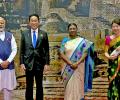
They welcomed the guests before the start of the dinner from the reception dais, with its backdrop showcasing the ruins of the Nalanda University in Bihar besides India's G20 presidency theme -- 'Vasudhaiva Kutumbakam - One Earth, One Family, One Future'.

India is poised to be the fastest-growing major economy in the world and an engine of global growth despite global headwinds, says leading industrialist and Aditya Birla Group Chairman Kumar Mangalam Birla. The economic activity in India has witnessed a sharp recovery to pre-pandemic levels on the back of a rapid and widespread rollout of the vaccination programme, Birla said in the latest annual report of UltraTech Cement Ltd. "A strong digital ecosystem, fiscal and monetary policy and various government schemes helped small and medium enterprises and the worst affected sections of the population to survive while reviving demand and bringing the economy back on track," said Birla while addressing UltraTech's shareholders.
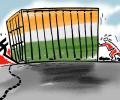
India has been relatively insulated from the severe headwinds in the West. However, with a third of the global economy expected to slip into recession in calendar year 2023, the impact will strongly be felt on India's exports and trade economy, leading economists said in a panel discussion at the Business Standard BFSI Insight Summit in Mumbai on Wednesday. The panel comprised former Reserve Bank of India executive director and former Monetary Policy Committee member Mridul Saggar, State Bank of India Chief Economic Advisor Soumya Kanti Ghosh, Citibank India Chief Economist Samiran Chakraborty, ICRA Chief Economist Aditi Nayar, and IndusInd Bank Chief Economist Gaurav Kapoor. The topic of the panel discussion was No recession in sight: Is India decoupled from developed economies?

The global recovery is expected to be asynchronous and divergent between advanced and emerging market economies, the IMF said on Tuesday, noting that policymakers should take early action and tighten selected macroprudential policy tools while avoiding a broad tightening of financial conditions. "Extraordinary policy measures have eased financial conditions and supported the economy, helping to contain financial stability risks," the International Monetary Fund (IMF) said in its Global Financial Stability report released ahead of the Spring meeting of the global lender and the World Bank. However, actions taken during the pandemic may have unintended consequences such as stretched valuations and rising financial vulnerabilities, it said.

Only India is anticipated to witness better growth momentum among the BRIC bloc

The United States has said that in-person registration of domestic workers of foreign diplomats would be mandatory, an apparent fallout of the arrest of Indian diplomat Devyani Khobragade over alleged misrepresentation of the salary paid to her maid.

The second-quarter GDP numbers are scheduled to be announced on Friday.

The mandates which Pakistan has failed include action against all United Nations-designated terrorists like Jaish-e-Mohammed chief Azhar, Lashker-e-Tayiba founder Hafiz Saeed and the outfit's operational commander Zakiur Rehman Lakhvi.

However, the World Bank has projected India's GDP growth rate at 7.5 per cent for the next three financial years, including the current one.
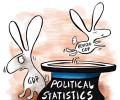
The Economic Survey 2022-23 (FY23), to be presented a day before Union Budget 2023-24 (FY24), is likely to project India's real gross domestic product (GDP) growth between 6 per cent and 7 per cent for FY24, Business Standard has learnt. The broader theme of the Survey could be on how India has dealt with two years of a global pandemic and the ongoing geopolitical disturbance, the strengths and weaknesses that emerged, and what lessons may be learnt. The much-awaited Survey will be the first one by Chief Economic Advisor V Anantha Nageswaran and his team in the finance ministry's economic division.

Thousands of demonstrators have hit the streets since April 9, as the government ran out of money for vital imports; prices of essential commodities have skyrocketed and there are acute shortages in fuel, medicines and electricity supply.
Indian capital markets joined the global sell-off sparked by China growth concerns
India's economy has bounced back amazingly from the Covid-19 pandemic and nationwide lockdown over the last one year, but it is not out of the woods yet, according to the World Bank, which in its latest report has predicted that the country's real GDP growth for fiscal year 21/22 could range from 7.5 to 12.5 per cent.

'A sustainable growth rate of 8 per cent is evidently some distance away,' says T N Ninan.

Pakistan has improved its full compliance on only two of the 40 FATF recommendations, the APG report noted.

'To the believers of crypto regulations, I have only one question to ask, how will you regulate it?'

Kaushik Basu, whose stint at the World Bank ends on July 31, was being looked at as a serious contender, the sources said

RBI must balance the need for improving domestic bank credit demand and respond to lower inflation.

The anti-government protests near the presidential secretariat in Colombo resumed on Sunday after the authorities lifted the nation-wide curfew to celebrate the Vesak -- what we call Buddha Purnima in India -- festival.

'We expect a pick-up in the second half of the current fiscal. But before that, data is likely to show a further slowdown. The second quarter print is likely to be worse than the first quarter,' said a senior official.
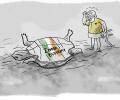
The International Monetary Fund (IMF) on Tuesday slashed India's growth forecast for 2022-23 (FY23) by 80 basis points to 7.4 per cent, citing less favourable external conditions and rapid policy tightening by the central bank. In its update to the April World Economic Outlook, the IMF said that though a global recession in 2022 was ruled out with a growth estimate of 3.2 per cent, the balance of risks was squarely to the downside, driven by a wide range of factors that could adversely affect the global economic performance. "The risk of recession is particularly prominent in 2023, when in several economies growth is expected to bottom out, household savings accumulated during the pandemic will have declined, and even small shocks could cause economies to stall.

IMF said in 2017, India is likely to grow at the rate of 7.2 per cent instead of the earlier projected 7.6 per cent.
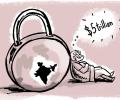
India decisively withstood global headwinds in 2023 and is likely to remain as the world's fastest-growing major economy on the back of growing demand, moderate inflation, stable interest rate regime and robust foreign exchange reserves. Despite widespread pessimism witnessed among the developed nations and the worsening geopolitical situation, India recorded a gross domestic product (GDP) expansion of 6.1 per cent in the March quarter. The growth moved up to 7.8 per cent in the June quarter and was 7.6 per cent in the September quarter. For the first six months of this fiscal, the growth was 7.7 per cent.

The International Monetary Fund (IMF) on Tuesday said it is expecting some slowdown in the Indian economy next fiscal year and projected the growth to 6.1 per cent from 6.8 per cent during the current fiscal ending March 31. The IMF on Tuesday released the January update of its World Economic Outlook, according to which the global growth is projected to fall from an estimated 3.4 per cent in 2022 to 2.9 per cent in 2023, then rise to 3.1 per cent in 2024. "Our growth projections actually for India are unchanged from our October Outlook.

We as customers have to be conscious and careful to sidestep numerous types of frauds made possible under a mindless shift to a digital ecosystem without customer-redress procedures, warns Debashis Basu.
The report cautioned that low capacity utilisation and stressed balance sheets of banks and businesses will prevent a strong investment revival in the short term.

India, Asia's third-largest economy, is likely to grow 5.3 per cent in 2013, the OECD said, lower than the November forecast of 5.9 per cent.
